
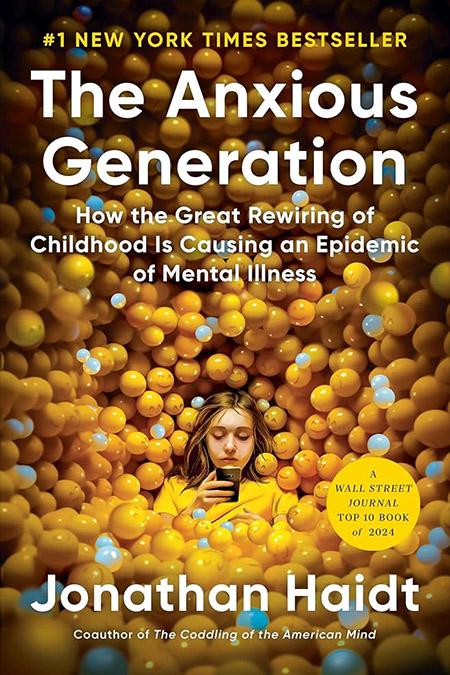
must-read for all parents: the generation-defining investigation into the collapse of youth mental health in the era of smartphones, social media, and big tech—and a plan for a healthier, freer childhood.
“With tenacity and candor, Haidt lays out the consequences that have come with allowing kids to drift further into the virtual world . . . While also offering suggestions and solutions that could help protect a new generation of kids.” —Shannon Carlin, TIME, 100 Must-Read Books of 2024
After more than a decade of stability or improvement, the mental health of adolescents plunged in the early 2010s. Rates of depression, anxiety, self-harm, and suicide rose sharply, more than doubling on many measures. Why?
In The Anxious Generation, social psychologist Jonathan Haidt (pronounced "height") lays out the facts about the epidemic of teen mental illness that hit many countries at the same time. He then investigates the nature of childhood, including why children need play and independent exploration to mature into competent, thriving adults. Haidt shows how the “play-based childhood” began to decline in the 1980s, and how it was finally wiped out by the arrival of the “phone-based childhood” in the early 2010s. He presents more than a dozen mechanisms by which this “great rewiring of childhood” has interfered with children’s social and neurological development, covering everything from sleep deprivation to attention fragmentation, addiction, loneliness, social contagion, social comparison, and perfectionism. He explains why social media damages girls more than boys and why boys have been withdrawing from the real world into the virtual world, with disastrous consequences for themselves, their families, and their societies.
Most important, Haidt issues a clear call to action. He diagnoses the “collective action problems” that trap us, and then proposes four simple rules that might set us free. He describes steps that parents, teachers, schools, tech companies, and governments can take to end the epidemic of mental illness and restore a more humane childhood.
Haidt has spent his career speaking truth backed by data in the most difficult landscapes—communities polarized by politics and religion, campuses battling culture wars, and now the public health emergency faced by Gen Z. We cannot afford to ignore his findings about protecting our children—and ourselves—from the psychological damage of a phone-based life.
THE INSTANT #1 NEW YORK TIMES BESTSELLER • Wall Street Journal Top 10 Book of 2024 • A New York Times and Washington Post Notable Book • One of Barack Obama's Favorite Books of 2024 • A TIME 100 Must-Read Book of 2024 • Named a Best Book of 2024 by the Economist, the New York Post, and Town & Country • The Goodreads Choice Award Nonfiction Book of the Year • Finalist for the PEN Literary Awards
Buy the book on Fishpond.

As the world digitises, children and adolescents are increasingly using digital technologies. These devices offer benefits such as exposure to social contacts and support, potential learning opportunities and access to health promotion material. However, along with these benefits, emerging evidence is indicating that frequent, extended use of digital devices is associated with negative impacts on the health and wellbeing of children and adolescents.
Read More
There's a new addiction in New Zealand - more than a third of Kiwis say they are hooked on their screens and many are blaming Covid for it. As the country enters its second week of lockdown, New Zealanders have been averaging five hours of screen time a day on top of using devices for work and school since the Covid pandemic started last year, a new NortonLifeLock study has found.
Read More
Hundreds of millions of dollars of grants go to community groups every year from gambling, including pokies, Lotto and casinos – but legal online casinos wouldn’t have to, under new government plans. Steve Kilgallon reports.
Read MoreWe greatly appreciate your feedback on this website and would like to know what information you found useful and what services you would like to see next. Please take a couple of minutes to let us know.
survey


